Chimamanda Ngozi Adichie on Hair, in Her Own Words
She calls herself obsessed with hair, and wrote a prize-winning novel about it. What Chimamanda Ngozi Adichie has said about relaxers, natural hair and beauty, the styles she wears and the people who do them.
"I am obsessed with hair!"
Most famous people have to be coaxed into talking about their hair. Chimamanda Ngozi Adichie, one of the most admired novelists alive, will bring it up herself, and has been doing so for more than ten years: on the radio, on television, in magazines, and across the 500 pages of a novel that she likes to describe as being "about love, about race, and about hair".
She has thought harder about Black hair in public than almost anyone, and she wears it beautifully. So for once in this section we will let the star do most of the talking.
"My hair story started when I was a baby"
She was born in Enugu, in south-eastern Nigeria, in 1977, to a mother who, she says, "desperately wanted a girl, a girl with hair".
The hair in question was soon being stretched with a hot comb, which she loved, except that "when the comb touched your ear it was so painful". By the age of three, she told the Telegraph in 2013, she had decided that "straight hair was beautiful and my hair was ugly".
At her secondary school, relaxed hair was not allowed. So relaxing became the thing every girl waited for. "The rite of passage from girl to woman is when you can go get a relaxer and have your hair straight," she told American radio. On her last day of school she went straight to the salon: "a huge girl occasion for me and my friends".
She remembered the smell of tonged, relaxed hair as well. "It smells just like burning goat."
"Why am I even doing this?"
At nineteen she moved to the United States to study. Salon relaxers there struck her as "needlessly expensive", so she bought a kit from the chemist and did it herself, "which didn't end well".
"Having then a scalp with really bad burns, I suddenly thought, 'Why am I even doing this?' And that's when I stopped using relaxers."
It was not an overnight conversion. "It took a while to accept my hair for the way that it grows from my head." She has described the change as "a journey from thinking that my hair was a problem to be solved". But she got there, and then some: by 2014 she was admitting to being "ridiculously pleased about having kinky hair".
The novel
All of this went into Americanah, published in 2013, which won America's National Book Critics Circle Award and has since been named among the best books of the century.
Its heroine, Ifemelu, is a Nigerian in America. The book opens with her taking a train to another town because the one she lives in has nowhere to get her hair braided, and the story keeps coming back to that braiding salon, hour after hour, as the braids go in. Along the way Ifemelu is advised to take out her braids and straighten her hair for a job interview, to look "professional"; the relaxer burns her; and a friend called Wambui finally sits her down and cuts the lot off. ("Relaxing your hair is like being in prison," Wambui tells her. The line is often quoted as Adichie's own. It belongs to Wambui.)
Thousands of women read that chapter and recognised their own bathroom mirror.
"Hair that grows up, not down"
Why does she care so much? Because, she says, hair is never only hair. She is interested in it "in a very aesthetic way, just the beauty of hair, but also in a political way: what it says, what it means".
A few of the things she has said it means:
- On beauty: "I'm obsessed with hair that grows up, not down." What puzzles her is how much time Black women spend chasing somebody else's idea of beautiful: "I find that very odd."
- On the office: "There isn't an objective idea of professional. It's something we've defined culturally," and "maybe it's time to expand that definition".
- On fancy dress: "I want people to stop wearing afro wigs at Halloween."
- On what she wants: "a world where black women's natural hair is an equal option". Or, more simply, for it to stop being remarkable: "It'd be lovely if it were just normal."
Her most quoted remark came in 2016, when she told Channel 4 News that if Michelle Obama had worn her hair natural while her husband was running for president, he would not have won, "because her natural hair would have signified certain things to people". It sounds like a joke. She did not mean it as one.
She is not telling you off
It would be easy to take all this as a lecture to every woman with a relaxer or a weave. She once called herself, half laughing, "a bit of a fundamentalist when it comes to black women's hair".
But asked about it by the Brazilian edition of Marie Claire in 2022, she drew the line carefully. A Black woman who decides to straighten her hair is making a decision she would not criticise "on a personal level". Her question is about the world around that woman: "Do we create an environment that allows and enables black women to wear their hair however they want? No, not yet."
That is our view too, for what it is worth. (Our own argument is in Nothing Wrong with Nappy Hair.)
The looks
She says she has her hair done in Lagos when she is home, and likes it because "I am watching the women in the salon". The styles are nearly always ones a West African grandmother would know.
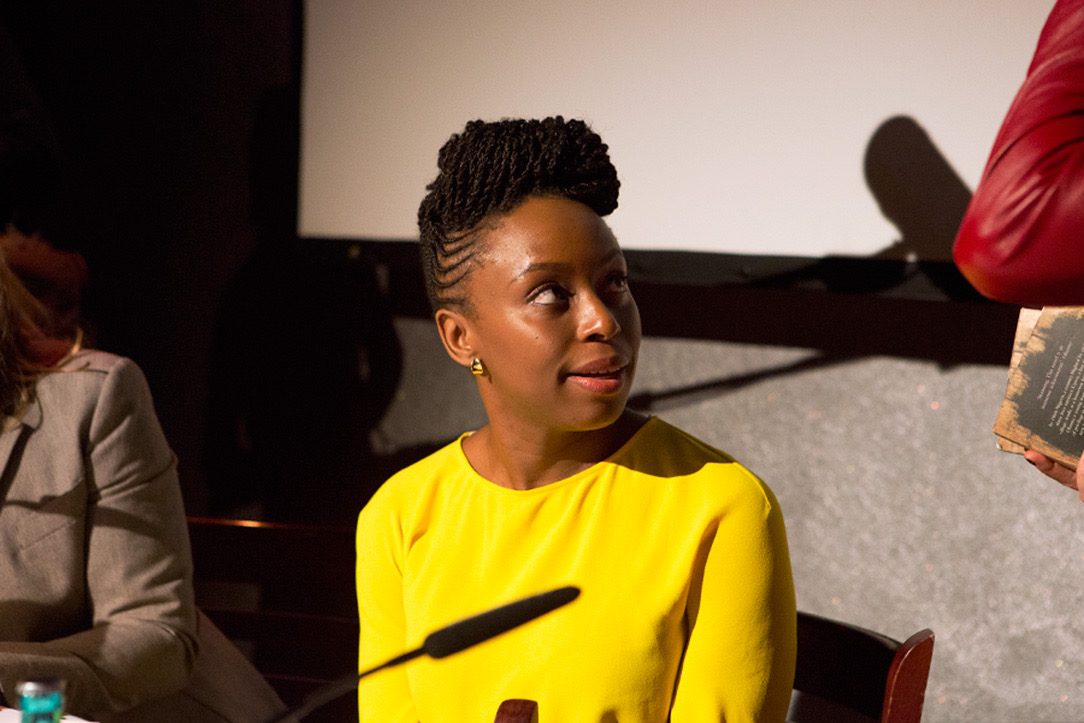
- Tiny cornrows and a ponytail (2013). How she described her own hair to the Observer during the Americanah interviews: "My hair is in tiny cornrows; I have a big ponytail on the top of my head. I quite like it. It is natural."
- Threading on the red carpet (October 2013). For the London premiere of the film of her novel Half of a Yellow Sun, she arrived in a red dress with her hair threaded: sections wrapped in black thread and shaped, a style from the Nigeria of the 1960s in which the book is set. It may be the most glamorous outing thread has ever had. We explain how it is done in African hair threading.
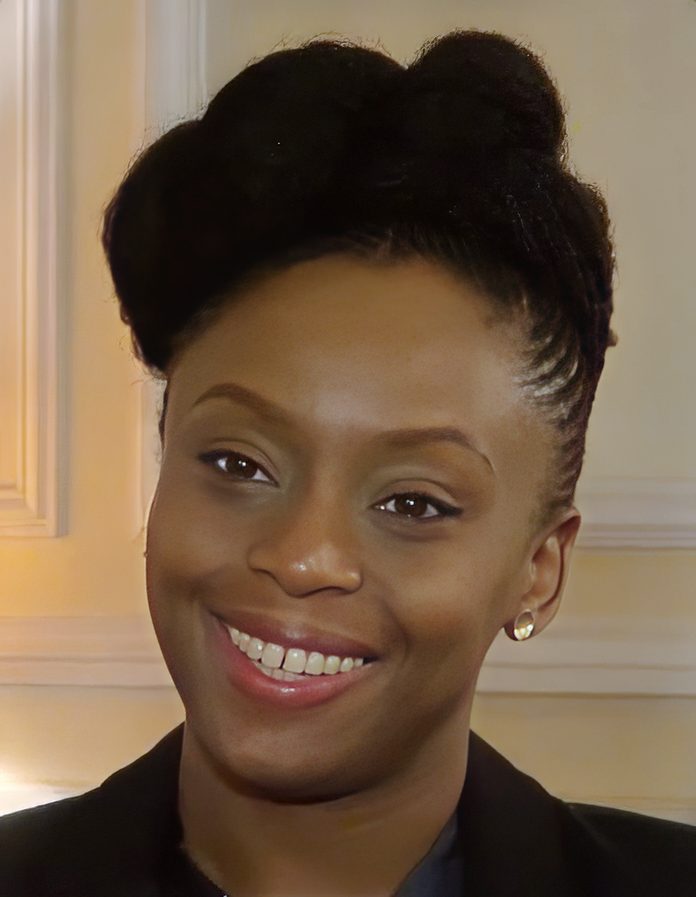
- The big updo (2017). On tour for her book Dear Ijeawele she wore a series of tall, dramatic updos, her hair gathered high and shaped.
- Soft curls (2021). For the cover of the Lagos magazine SCHICK, her natural hair was worn out in full curls.
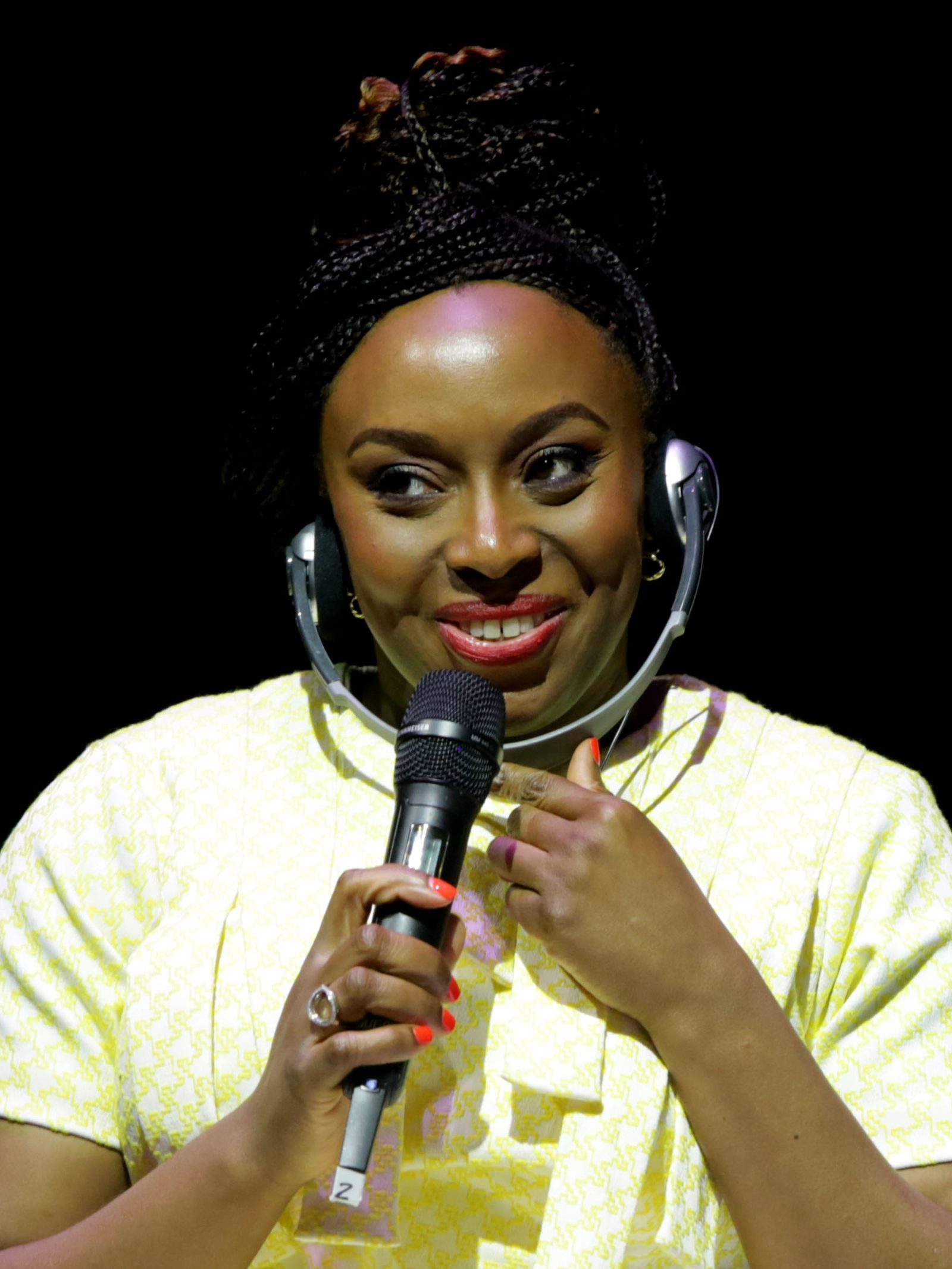
- Braids, piled high (June 2025). On the Dream Count tour she moved between braids, soft curls and twist-outs. In Sao Paulo the braids were gathered up on top of her head.
- The crown (July 2025). Back in Enugu on tour for her novel Dream Count, she had her coils gathered into a crown-like updo by a local stylist. That one comes with a story.
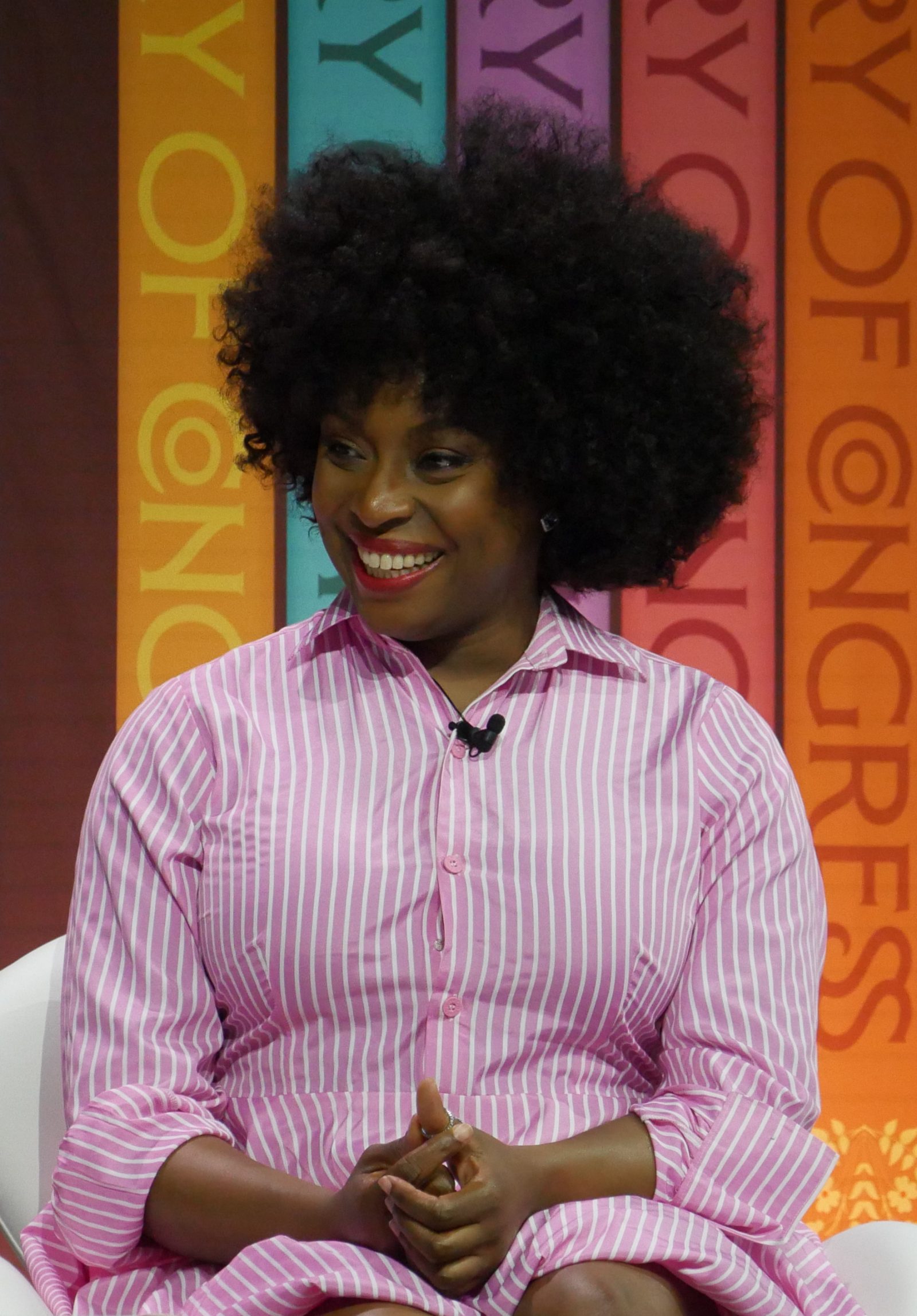
- The afro (September 2025). At a book festival in Washington she simply wore it out: big, round and unapologetic. It is the picture at the top of this page.
The woman who wrote it down
In April 2020 a young hairdresser in Enugu called Happiness Okorie wrote a note inside her copy of Half of a Yellow Sun: "Dear Chimamanda, this is to let you know that someday, I will style your hair."
Okorie had taught herself to care for natural hair after relaxers burned her own scalp, and had built a small natural-hair salon in the city. Five years after the note, the novelist came home to Enugu, and sat down in her chair.
"What an honour and a dream come true to style your beautiful hair," Okorie wrote afterwards.
Others who have done her hair include Charlotte Mensah, whose salon on Portobello Road in London is a place of pilgrimage for natural hair, and the Lagos salon Tasala HQ.
Borrow from her
- Go back to the old styles. Cornrows, threading and a well-shaped updo are not "just for the house". She has worn all three in front of the world's cameras.
- Find someone who knows natural hair. Every stylist named here specialises in it. If your salon's only suggestion is a relaxer, it is the wrong salon for the job. Our guide to going natural covers the first steps.
- Wear it without apology, and let other women do the same. Her point has never been that everybody must go natural. It is that nobody should have to explain themselves if they do.
Sources
- NPR Fresh Air, 27 June 2013: interview with Terry Gross
- NPR, 11 May 2013: a novel about love, race and hair
- The Kojo Nnamdi Show, 24 July 2013: interview and transcript
- The Rumpus, 17 June 2014: interview by Kima Jones
- Atlanta Black Star, 11 August 2016: report of the Channel 4 News interview
- BellaNaija, 29 November 2022: Marie Claire Brazil cover interview
- BellaNaija, 21 October 2013: the London premiere of Half of a Yellow Sun
- Legit.ng, 27 August 2025: the hairdresser's note
- Qazini, 16 February 2026: Happiness Okorie and her salon
Picture credits
All from Wikimedia Commons, used under the Creative Commons licences shown.
- Main picture, Washington, September 2025: Sizzlipedia, CC BY-SA 4.0
- Berlin, May 2014: Tammi L. Coles, CC BY-SA 4.0
- Early 2015: Librairie Mollat, CC BY 3.0
- Sao Paulo, June 2025: Greg Salibian, Fronteiras do Pensamento, CC BY-SA 2.0