The Afro Comb: 5,500 Years and Counting
The long-toothed comb is one of the oldest tools still in daily use. Its story runs from the graves of ancient Egypt to a 1970s factory in Pennsylvania, a police stop in London and the Met Gala.
Somewhere in your house there is probably one right now: at the back of a drawer, in the glove box of the car, or standing up in somebody's hair. A handle, a row of long, widely spaced teeth, and very often a clenched fist on top. It cost about a pound.
It is also one of the oldest designs still in everyday use. When the Fitzwilliam Museum in Cambridge put on an exhibition about the afro comb in 2013, the curator, Sally-Ann Ashton, placed a plastic black-fist comb in a case beside a comb carved in Egypt around 5,500 years ago. The two are, to all intents and purposes, the same object.
The first combs
The oldest comb in that exhibition came from a grave at Abydos, in Egypt, and dates from before the pharaohs. Others like it are a little older or a little younger, in bone and ivory, with long teeth and handles carved into birds, antelope, hippos and giraffes.
A few things about them are worth knowing.
- They were picks. "The earliest combs were in the form of a 'pik'," Ashton writes: upright, with long teeth, not the flat fine-toothed comb of ancient Europe.
- The teeth are wide apart. That gap is the main difference between combs from Kemet (the ancient Egyptians' own name for their country) and European ones, and the reason is the hair they were made for. Tightly coiled hair breaks if you drag a fine comb through it.
- They were worn, not just used. They are found in the graves of important people, and were, in Ashton's words, "status symbols, decoration for the hair, and tools". All three at once, which is still true.
One caution, and it is the curator's own. A comb from 3500 BC looking like a comb from 1975 does not prove an unbroken line between the two. Nobody can show every link in the chain. What we can say is that people with this hair, in very different places and ages, have kept arriving at this shape, because it works.

A comb as a love letter
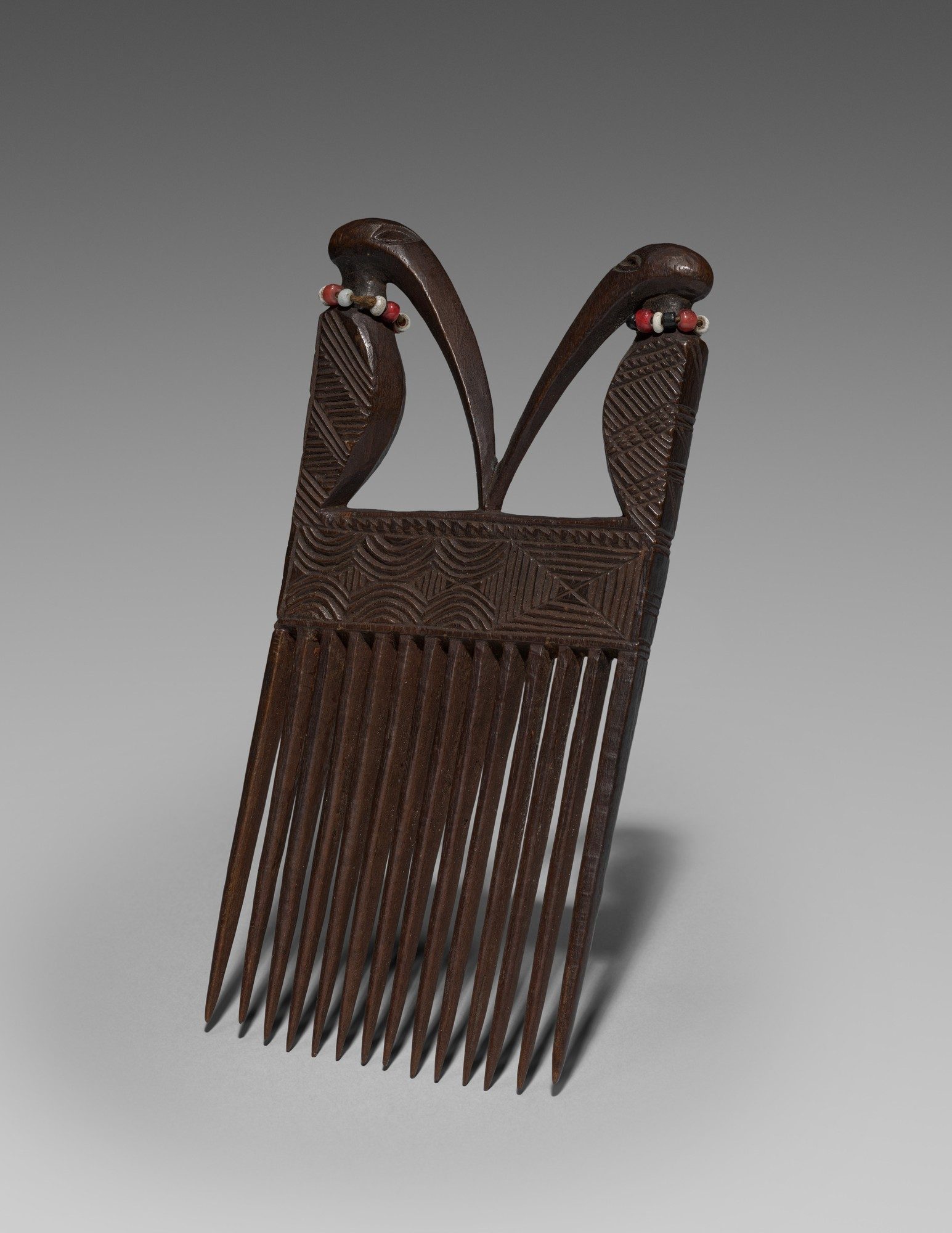
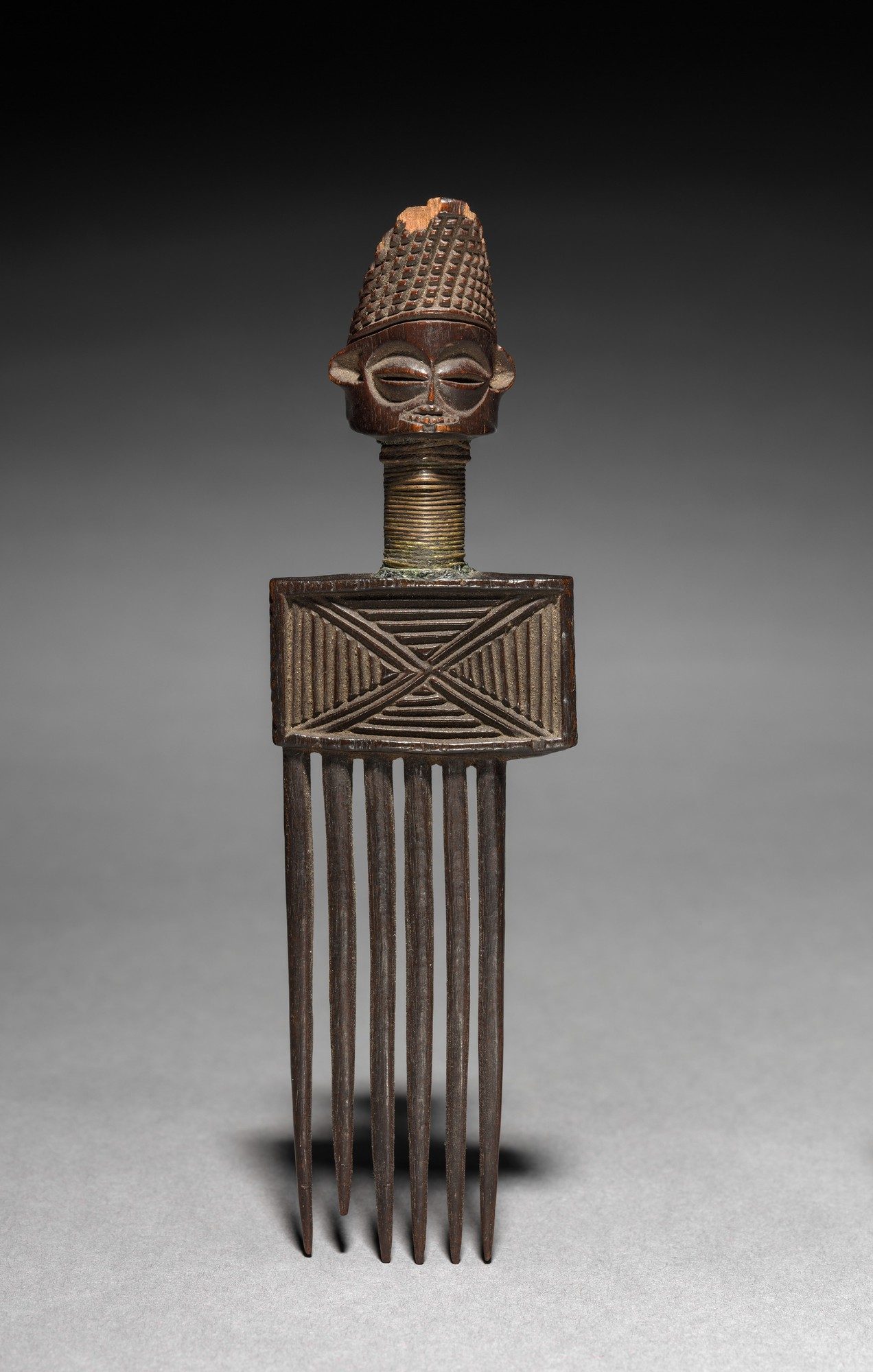
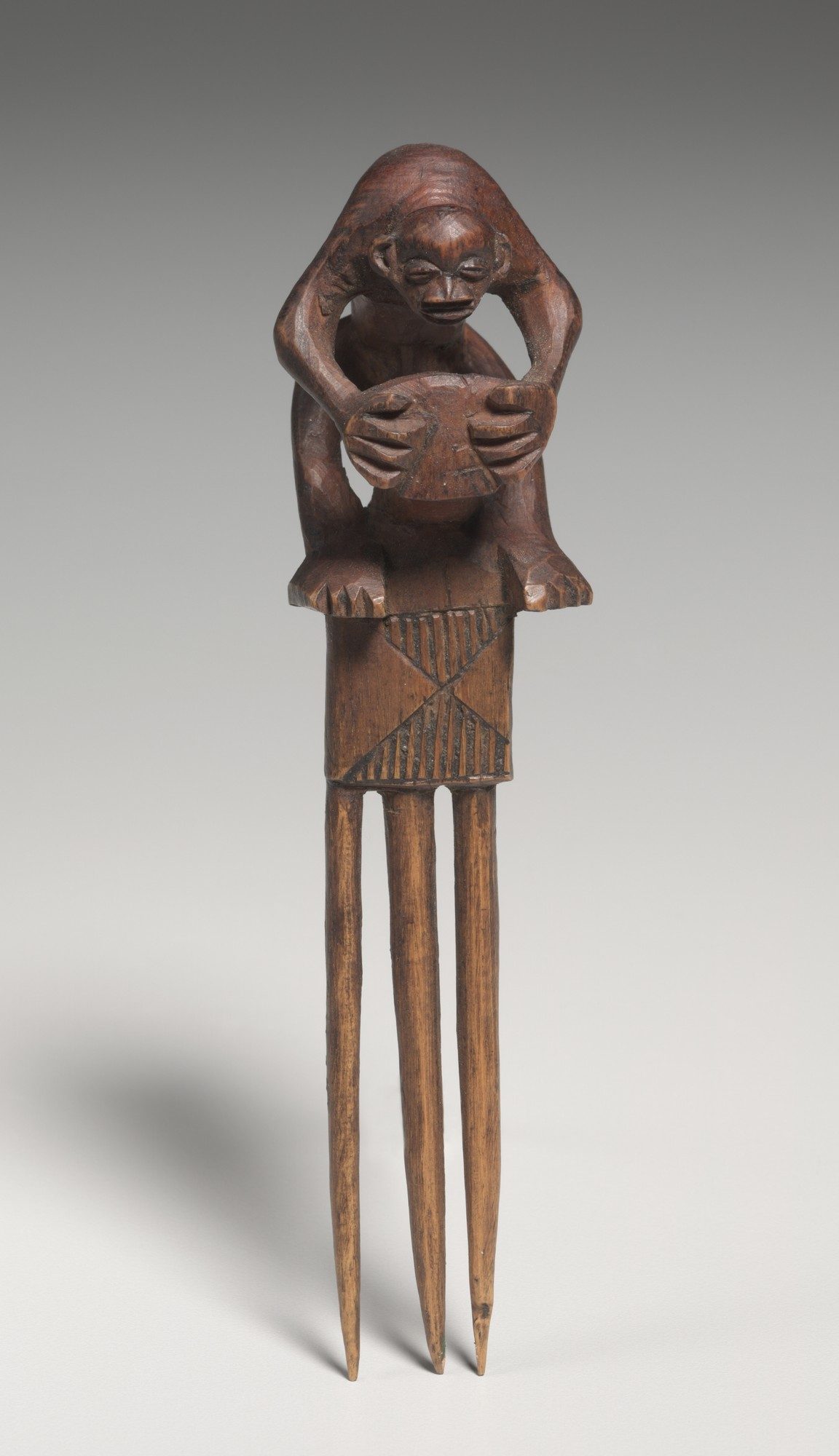
Across the continent in later centuries the comb went on being far more than a tool. Museums are full of them: wooden combs from Ghana, beaded ones from Angola, ebony from the Swahili coast, ivory, bone and brass. The Fitzwilliam sums it up: in many African societies the hair comb "symbolises status, group affiliation, and religious beliefs".
The best known are the Akan combs of Ghana, called duafe. These were presents. According to the Metropolitan Museum in New York, a woman would be given one by her family or by a husband or admirer to mark a great occasion, such as her marriage or the birth of a child, and the handle might be carved with figures chosen specially for her.
Imagine being handed a comb that somebody had spent weeks carving for you. Then look at what we give each other now.
The Atlantic
Then came the slave ships. Captives commonly had their heads shaved before the crossing. The reason given was hygiene, but as the Cambridge scholar Mathelinda Nabugodi has written, the act also stripped people of the styles that told the world who they were: their family, their people, their standing.
On the other side there were few combs made for their hair and little time to use one. The historians Ayana Byrd and Lori Tharps record that some enslaved people resorted to the wire-toothed cards used for combing out sheep's wool. Others, it seems, carved their own: combs made by enslaved people in America have been found that are almost identical to ones dug up in Ghana.
For the next few centuries the fashion, and the pressure, ran the other way: towards straightening. The long-toothed comb never vanished, but it went quiet.
1969: the comb comes back
It came back with the afro. A big round afro has to be lifted from the roots and shaped, and an ordinary comb cannot reach. In 1969 two African American men, Samuel H. Bundles Jr. and Henry M. Childrey, patented a long-toothed comb for the purpose. Others followed within a few years.
Then, in 1972, a Pennsylvania businessman called Anthony R. Romani designed the one everybody knows: the "styling pik" with a handle in the shape of a clenched fist, and a peace sign at its centre. He applied for a patent in January 1974 and was granted it in February 1976.
The fist was the Black Power salute, and people who wore the comb standing up in their afro knew exactly what they were saying. It may be the only political statement in history that was also good for detangling. Within a few years it was being made around the world, including, from at least the early 1980s, in Nigeria.
"Potential weapons"
Not everyone was charmed. In Britain in the late 1970s and early 1980s, the comb was, as Ashton puts it, "demonised". People who took part in the Cambridge project remembered being stopped and searched by the police and having their combs taken away because they were seen as potential weapons.
Think about that for a moment: a comb, confiscated. It belongs in the same file as the school rules and workplace bans we wrote about in Locs and the Rule Book, where the hair that grows from a Black person's head, and now even the tool for combing it, is treated as a threat.
From the back pocket to the museum
The comb won in the end, as good designs do.
The drummer Questlove of The Roots wore one in his afro for so many years that it became his signature (he retired it in 2021, saying he was tired of going back to look for it, which anyone who has ever owned one will understand). The artist Hank Willis Thomas made an afro pick eight feet tall, fist and all, called All Power to All People, and stood it across from City Hall in Philadelphia in 2017. A later version was 28 feet high.
And at the Met Gala in 2019, Lupita Nyong'o arrived with five of them, sprayed gold, set into a towering afro. (There is more on that in our Lupita Nyong'o hair timeline.)
Meanwhile the originals sit in glass cases in Cambridge, London, New York and Cleveland. The plastic fist comb is in museum collections too.
How to use one
A pick and a wide-tooth comb do two different jobs.
To detangle, use the wide-tooth comb, and never on dry hair. Dermatologists' advice is to wet the hair, work in a conditioner or leave-in conditioner, take it a section at a time, and be gentle. Many people also find it easiest to start at the ends and work back towards the roots.
To lift and shape, use the pick. Slide it in at the roots, lift outwards a little, and take it out again without dragging it through to the ends. You are raising the hair, not combing it. Then pat the shape round with your hands.
Our basics of Black hair care has more on combing without breakage.
Then put the comb somewhere you will find it again. People have been losing these for five and a half thousand years.
Sources
- University of Cambridge, 2 July 2013: Origins of the Afro Comb exhibition
- Fitzwilliam Museum: Origins of the Afro Comb, online resources
- Sally-Ann Ashton, 24 February 2016: Combs from Kemet
- Sally-Ann Ashton, History Workshop, 10 February 2014: Radical Objects: The Black Fist Afro Comb
- Metropolitan Museum of Art: Duafe (comb), Akan peoples
- Mathelinda Nabugodi: Afro hair in the time of slavery
- United States design patent 238,821: Comb Handle, Anthony R. Romani
- Monument Lab: Hank Willis Thomas, All Power to All People
- American Academy of Dermatology: curly hair care tips
Picture credits
All four photographs are from the Cleveland Museum of Art's Open Access collection and are in the public domain (CC0).